Ceremony Scripts: Keep the Meaning, Cut the Filler
Shape a ceremony around the people, promises and moments that matter, then edit readings and remarks until every part has a clear reason to be there.
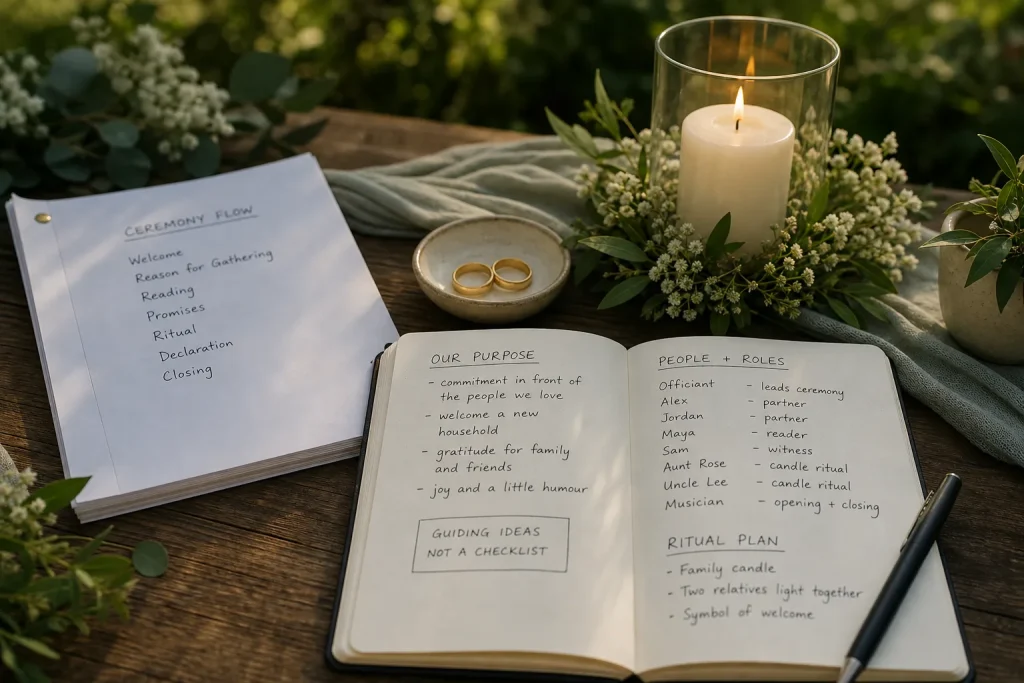
The common mistake is to build a ceremony by collecting familiar readings, rituals and speeches before deciding what the couple wants guests to witness. The result can feel borrowed and overlong, while the people at its centre have little room to speak in their own voices. A short, deliberate planning routine helps you keep the moments with meaning and let the rest go.
Set aside a week to draft the ceremony, with one focused task each day. You do not need to write polished prose at the start. First identify who is taking part, what the ceremony should express and which practical requirements cannot be omitted.
Day one: name the purpose
Each partner should write a few plain sentences about what they want guests to understand or feel by the end. Keep the answers private at first, then compare them. Look for shared ideas such as commitment, family, humour, faith, remembrance or welcome, rather than trying to turn every preference into a separate feature.
Choose a small number of ideas to guide the script. A ceremony about making promises in front of family, for instance, may not also need a long account of how the couple met, a sequence of unrelated readings and several people offering advice. The guiding ideas are an editing test, not a list of lines that must be repeated aloud.
Check any requirements with the person leading the ceremony, especially if a religious or civil framework applies. Ask which wording or actions are required and which are optional. Keep that information distinct from personal choices so that later edits do not accidentally remove something necessary.
Day two: map the people
Write down everyone who might speak or take part, including the officiant, the couple, readers, witnesses and anyone involved in a ritual. Beside each name, note what that person would contribute. A role should have a purpose, not exist only to avoid disappointing someone.
Consider the comfort and circumstances of each participant. A relative who dislikes public speaking might prefer to take part in a quiet action rather than read aloud; someone joining remotely may need a different role. Ask directly and give people a graceful way to decline.
Now make a rough sequence using plain labels: welcome, reason for gathering, reading, promises, ritual, declaration, closing. Add only the parts that serve the ideas chosen on day one or meet a requirement. Leave uncertain slots blank instead of filling them with standard wording by habit.
Day three: choose readings
Collect possible readings in one document, with the source and the intended reader beside each. Include a poem, a passage from a book, a prayer or a piece of writing created by someone close to the couple only if it fits the tone and the setting. Read each option aloud; a passage that looks lovely on a screen may be difficult to follow when heard once.
For each reading, ask what it adds that the rest of the ceremony does not. If two pieces make the same point, keep the one that sounds more natural for the reader and the occasion. If neither connects with the couple’s chosen ideas, remove both rather than keeping one merely because it is customary.
Check permissions with the venue or officiant where relevant, and make sure the reader has the final text in good time. Offer a printed copy in a clear, easy-to-read format. The reader should not have to search through a phone while guests wait.
Day four: assess rituals
For each proposed ritual, write down what happens, who takes part and what the action means to the couple. A candle, shared cup, handfasting cord or family blessing can be moving when the people involved recognise its meaning. Without that connection, it may read as decoration inserted into the ceremony.
Think through the practical details as well. Confirm who supplies the materials, where they will be placed, whether the action can be seen from the seats and who will clear the area afterwards. Ask the officiant to explain the action briefly if guests are unlikely to understand it, but keep the explanation in the couple’s language rather than adding a long history that does not belong to their story.
Say you are planning a small ceremony in a garden and considering a family candle ritual. Imagine that the couple decides its real meaning is the welcome of a new household, asks two relatives to light the candle together and removes a second symbolic action that would repeat the same idea. The expected result is a clearer moment, with fewer objects to arrange and a role each relative can understand.
Day five: edit remarks
Ask the officiant and any speakers to keep their remarks focused on the ceremony’s purpose. A brief personal observation can make a welcome feel specific; a long biography or a run of jokes may pull attention away from the promises. Give speakers a clear time expectation in conversation, not as an unexplained command.
Read the draft aloud from beginning to end. Mark sentences that repeat an idea, explain what guests can already see or sound unlike the person who is meant to say them. Replace formal phrases with ordinary language where the ceremony’s rules allow it. A script should be easy to speak, not just elegant on the page.
Keep one pause after an emotionally weighty moment, such as a remembrance or a set of promises. Silence can give guests time to take in what they have heard; it need not be filled by another quotation or transition.
Day six: check the flow
Give the full draft to the officiant and participants who need to approve their parts. Ask them to flag unclear transitions, unfamiliar names and words that feel awkward aloud. Resolve questions together, especially where the order of events or a required phrase is involved.
Walk through the sequence in the actual space if possible, or talk it through with a simple room sketch. Check where readers stand, how the couple enters and exits, and whether guests will be able to see any ritual. If the ceremony includes music, mark where it starts and stops; a cue written as “after the reading” is clearer than a vague note in the margin.
Prepare a clean copy for the officiant, with speaker names and cues easy to spot. Share individual sections with readers rather than sending everyone a crowded working document. Keep a backup copy with the person coordinating the day.
Day seven: make the cut
Read the script once more and apply a simple test to every element: does it express one of the couple’s chosen ideas, meet a requirement, or help a person take part? If the answer is no, remove it or ask whether its purpose can be met in a more direct way. Do not keep a passage only because someone has already formatted it or because it appears in a sample script.
Then check the beginning and ending. Guests should understand why they have gathered, and the close should lead naturally into the next part of the day, whether that is a procession, photographs or a reception. Confirm the final version with the officiant and participants, and avoid late additions unless they solve a real problem.
Leave the finished script with one person responsible for the working copy, and give readers their own final text. On the day, this small piece of organisation protects the ceremony’s quietest moments: everyone knows when to speak, what to do and, just as importantly, when to let the words stand on their own.