Seating Plans Without the Family Puzzle
A reception seating plan works best when it solves practical needs first and leaves ordinary differences room to breathe. Start with access, table shape and a few clear constraints—not a theory about every relationship.
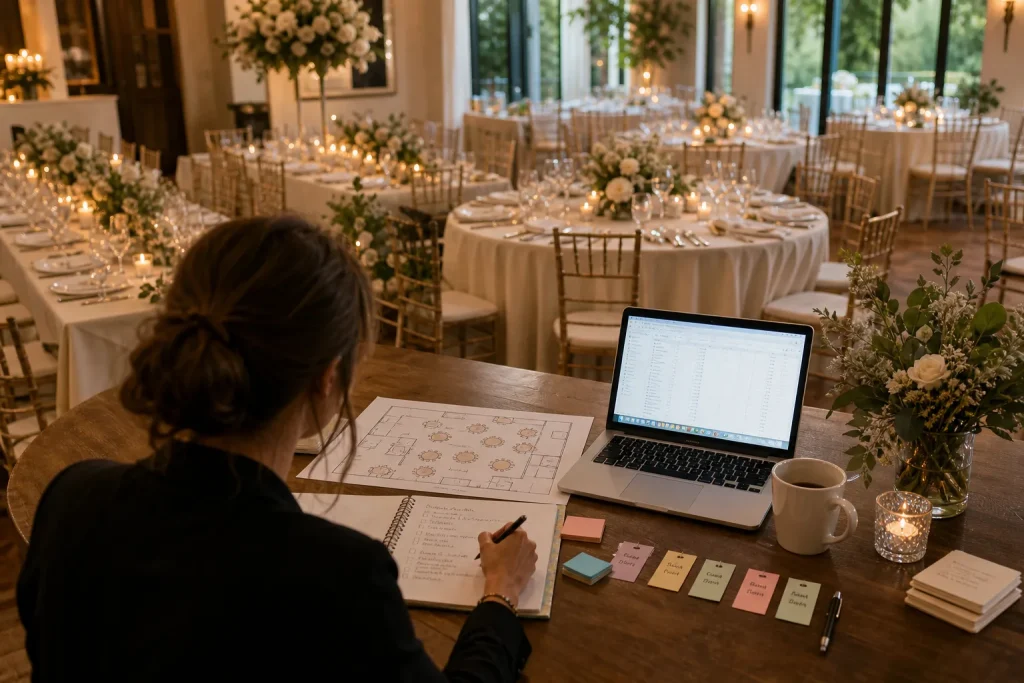
The most common seating mistake is trying to prevent every possible awkward conversation by assigning each guest a place in a complicated social puzzle. It costs time, adds pressure to relationships that may be perfectly manageable, and can leave practical needs—such as a clear route to the bar or a chair beside a partner—unnoticed. Begin instead with what guests need to sit comfortably, then arrange the remaining places with a light touch.
What should I solve first?
Start with access and comfort: who needs a particular seat, who should sit together, and what routes must remain clear. These are useful constraints because they affect whether someone can participate easily, not because they reveal anything about the quality of a relationship.
Ask guests discreetly about requirements that may affect seating. Someone may need space for a mobility aid, a quieter place, an easy route to the toilets or a chair that is not at the end of a long table. Confirm such needs with the guest rather than making assumptions from age, appearance or family role.
Then check the room plan with the venue. A table that looks roomy on paper may narrow a passage once chairs are pulled out. Keep paths to entrances, exits, accessible facilities and service points usable, and ask the venue coordinator to flag any layout constraints before you place names.
Should I group people by relationship?
Use relationships as a starting point, not a rule. Guests who know one another often enjoy sharing a table, but a table can also work well when it brings together people with an easy conversational connection, such as friends who enjoy gardening or relatives who share a local connection.
Avoid treating family branches as fixed units that must sit together. Couples and close companions will usually appreciate being seated together, while wider groups can be split if the layout calls for it. If you do separate people who might expect to sit together, check privately that the arrangement suits them rather than trying to infer their preferences.
Nor does every table need a designated “connector” tasked with keeping conversation alive. Most guests can manage a meal without being assigned a social job. Choose a balanced mix where convenient, then let people talk—or enjoy a quieter meal—without expecting a particular performance.
What if relatives do not get along?
Make a seating decision only for a concrete concern, such as a guest asking not to share a table with someone, or a recent disagreement likely to cause a scene. A general sense that two people are “difficult” is not enough to justify elaborate arrangements or public commentary.
When there is a clear concern, ask the people involved what would help them feel comfortable. Keep the conversation private and practical: they might prefer separate tables, a seat near a trusted companion, or simply not to be placed side by side. You do not need to disclose one guest’s private explanation to another.
Then set a proportionate boundary. Separate the guests if that is the sensible choice, but do not scatter an entire family or recruit other guests to monitor them. If you have reason to expect behaviour that could make someone feel unsafe, speak with the venue or a suitable professional about the day’s arrangements; a seating chart cannot carry that responsibility by itself.
How do I handle uneven groups?
Let the room and table format guide the answer before trying to make every group mathematically even. A long table may naturally mix friends and relatives, while round tables may make it easier to seat smaller circles. Ask the venue which layouts fit the space and its service plan.
It is usually kinder to split a large friendship group between neighbouring tables than to place one person alone with strangers. When you divide the group, look for companions who already know one another or share a likely point of conversation. Check that no one is isolated simply because the remaining names happened to fit the chart.
Say you have a group of six friends and room for two of them at a table with relatives they already know. You could place the other four at a nearby table with two guests who share their interest in live music; the practical result is that each table has familiar company, without presenting the split as a verdict on anyone’s closeness.
How should children and companions fit?
Seat children according to their age, needs and the preferences of the adults responsible for them. Some families may prefer children beside their parents; others may be comfortable with a children’s table if it is supervised and suits the venue. Ask rather than assuming that every child wants the same arrangement.
Keep any children’s table close enough for parents or carers to check in, and confirm with the venue whether the table, menu and space are suitable. Do not place a young child in charge of another child simply to make the numbers work.
For guests who have not yet confirmed a companion, avoid building a fragile plan around a presumed attendance. Reserve a flexible place where possible and ask the guest about their arrangements before printing the seating display. A companion should not be added to a table as an afterthought if the table would then be cramped or separated from the person they came with.
What is the simplest way to draft it?
Use a spreadsheet or a printed room plan, whichever makes changes easiest to see. Keep one column for names and another for confirmed needs or requests; record only what is useful for the seating decision, and keep sensitive notes private.
- Confirm the final guest list and who is attending with a companion.
- Get the venue’s table shapes, capacities and access requirements.
- Place guests with specific seating needs and the people they need beside them.
- Keep partners and close companions together unless they have asked otherwise.
- Group remaining guests by familiarity or an easy shared point of conversation.
- Check that each table has a workable mix without assigning anyone a social duty.
- Review the room routes and ask the venue coordinator to check the layout.
Leave a little flexibility until the venue’s final arrangements are confirmed. If a late change affects one table, adjust nearby places rather than rebuilding the entire chart. Keep a dated copy of the current plan so that family members and venue staff are not working from competing versions.
How should guests find their seats?
Choose a display guests can read as they enter the reception. A simple printed list organised by table name or number is often clearer than a decorative chart that forces people to search through dense lettering. Make sure the names are spelled correctly and the display is placed where guests can pause without blocking the entrance.
If guests need to find an individual place, provide a clear name card at each setting. Table names can be more personal than numbers, but avoid titles that are hard to pronounce or distinguish at a glance. Ask the venue who will set out the cards and when the final seating file must be delivered.
Keep a copy of the chart with the person coordinating arrivals. They can answer questions quietly if a guest’s name is missing or a last-minute change has occurred, without turning the entrance into a public discussion of family arrangements.
When is the plan finished?
The plan is finished when access needs are covered, the venue can use the layout, companions and requested pairings are respected, and there is no known practical problem left to resolve. It does not need to prove that every guest has been placed with their ideal set of conversational partners.
Once those conditions are met, stop rearranging seats to answer imagined objections. Share the final version with the venue and the person greeting guests, and keep private explanations off the public chart. A thoughtful seating plan gives people a comfortable place to begin the meal; it does not have to decide the shape of every relationship in the room.
One useful final check is to look at the chart from the guest’s point of view: can they find their name, reach their seat and sit with the person they reasonably expected to be beside? If the answer is yes, the remaining uncertainties belong to conversation, not to the seating spreadsheet.